


The language we use shape, not only how we relate to things, but define what is possible and what is not. A concept must be imagined before it can be brought into existence. If words do not sufficiently encompass said concept, then new words must be invented, or its manifestation may remain beyond grasp.
There’s an urban legend, which I recall from the time but now understand to be false, that President Bush declared that the reason French people are bad at business is because the French do not have a word for “entrepreneur”. It’s humorous and I use it to elucidate the point, but I accept that it’s probably a fiction.
Nevertheless the point is a serious one. If you reduce the language, you reduce that which can be imagined and stymie what is possible.
Nowhere is this more pertinent than in programming in which we do not work with concrete things, but with the abstract. Therefore, the concepts we wield are expressed in terms of metaphors from the outside world. For example, what is the meaning formed by the use of “web” and “site” when used together? When a computer system starts up, the process was originally imagined as pulling itself up by its bootstraps, hence it “boots up”. There are endless technical terms such as: bit, byte, and nibble.
Ultimately, everything is metaphor that carries significance from the outside world.
As a programmer, I have to find names for things all the time. The most useful tool in programming was, until AI, a thesaurus. But what happens if it becomes no longer acceptable to use many long established terms, especially those with rich meanings?
I once named a class (a metaphor for an area functionality) using the suffix “manager” to indicate how I perceived its function. The use of “manager” as a suffix is common, as in a DisplayManager, for example. My class proved troublesome, however, as the internal logic associated with managing things became complex. Then I realised that this complexity existed only because I saw it as a manager of things and, so implemented features associated with managing.
When I renamed it to “helper”, much of the unnecessary complexity simply vanished in my mind, and I stripped it back.
Now, what if the term “helper” was banned in programming, not for technical reasons, but for cultural ones? Suppose the use of the word could imply that some people need help and are therefore helpless, with this being seen as discriminatory and offensive?
Suppose my development environment treated it as error and flagged me as a transgressor. This may be bizarre, which indeed it is, but as many readers are now aware, words routinely become verboten for no less bizarre reasons.
In the software world, Coding Style, User Interface Guidelines and the so called Code of Conduct policy documents associated with open and commercial projects are the tools of cultural engineering and enforcement.
The Code of Conduct (CoC) policy defines what is permissible to say or not say on a personal level, and are ubiquitous in open source projects funded by large corporations. It typically describes reporting and enforcement procedures. Smaller projects tend to have them also because they wish to be seen to following “best practice”.
The GNOME software CoC, for example, provides an extensive list of “protected characteristics” which cannot be referred to, including: body size, caste, citizenship, disability, ethnicity, gender expression, gender identity, gender expression etc., but explicitly makes the following behaviour permissible: reverse racism, reverse sexism and cisphobia. This applies to private offline conversations also, with a procedure to report transgressors.
Within programming and technology, the metaphor of “master” and “slave” have a long established history of their own stretching back decades. These two terms are top of the list in being unwords no longer used in modern development. Past examples would include a “master drive”, or the “master-slave nodes” of a database system, or a “master clock” etc..
In the 1982 movie, Tron, we had the Master Control Program.
Until recently, for example, the software control management system known as “git” (itself an offensive term) had the concept of a master branch. To forcibly change this overnight would break countless projects throughout the world. Instead, programmers are met with the following gentle encouragement to change it when creating new projects.
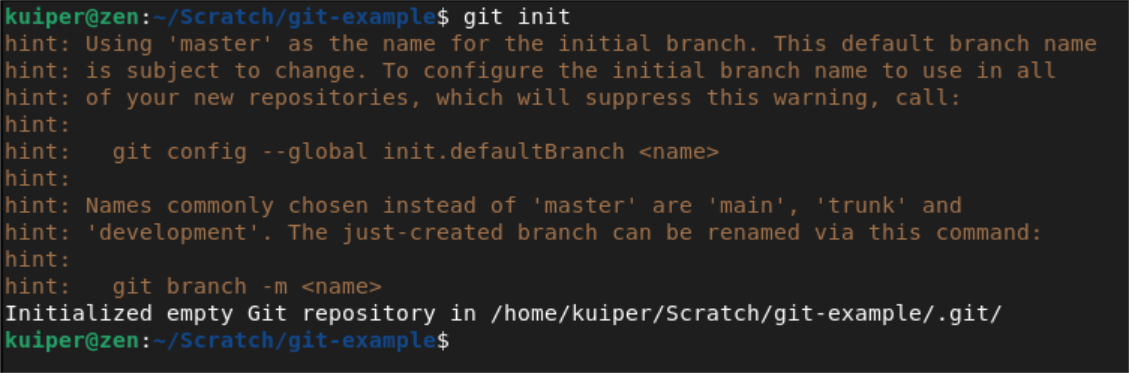
New projects tend to acquiesce so as to be in compliance with industry practice. Early self-compliance is, therefore, a gentler kind of violence to oneself in the ask-tell-make approach of engineering people.
The Linux Kernel Coding Style, to be fair, is relatively light in terms of unwords with respect to their direct use in source code, with only the following explicitly prohibited: master, slave, blacklist and whitelist.
The official Apple Style guide further adds terms that can be seen as violent, ableist or gendered, including: kill, hung, dummy, grandfathered, and sanity.
Others which appear a little more activism oriented, such as the Academy Software Foundation and Association for Computing Machinery, provide long lists of prohibited terms, including: abort, terminate, normal, owner, native, housekeeping, black-box, black-hat, white-hat, him, her, he, she, insane and legacy.
In Linux itself, however, it is still possible for the time being to type “kill -9” at the command line in order to terminate stop an application that has hung, erm… stopped.
I had presumed the word “hung” was forbidden because it may incite a hanging, but no… the ASWF clearly states that the word itself practices “a degree of machismo”. I didn’t think of that one actually. Clearly I am need of further re-education.
While I have dutifully censored myself over the years, I see now that I am guilty of using the words “housekeeping,” “terminate” and “abort” at various times in my own code. I can only apologise here and say that I didn’t know and… oh what the hell… I’m not really sorry at all! Of course I’m not.
I’m personally through with this nonsense!
I had to think up a name for an abstract thing (a kind of list) within my own code a few weeks back. I was naturally inclined call this thing “master”, as in a master index, and I refrained from the self-censorship and just used the damn word.
Here, look, there you go:

While agreeable and rational people may acquiesce that “main” can be used as an acceptable replacement for “master” in a technical context, master carries a higher word sense and lessons from the past. It’s interesting to note, therefore, that the ASWF guide explicitly urges the avoidance of any term with any social history whatsoever. Therefore, all words are to carry minimal meaning by default.
However, in erasing the language of the past, do we not also erase its lessons? And this possibly is the thing, is it not? To erase the lessons of the past so that they be played out again?
If we obliterate the words master/slave for future generations, how can they know that they are in a master-slave relationship?
While I’m not suggesting there is a direct link with AI here, I cannot help but find it poignant how the luminaries of the technology world have been urging us to see machines, not as machines, but as some kind of superior partner or collaborator.
There is certainly a relation in terms of the use of metaphors that shape how we may think.
We are entering a world where we will learn to coexist with AI, not as its masters, but as its collaborators. – Mark Zuckerberg, CEO of Facebook
For example, you could be a radiologist, if you think about five to 10 years from now, you’re going to have an AI collaborator with you. – Sundar Pichai, Quoted from The Independent, April 19th, 2023.
So you essentially have a collaborator with you at all times, essentially have a tutor at all times, and so I think the ability for AI to elevate all of the people left behind is quite extraordinary … It’s no different than when you work with teammates or lab partners. -- Jensen Huang, Official NVIDIA blog, April 15th, 2024.
If I have a hammer with which I wish to hit a nail, I am not the hammer’s collaborator. The hammer is not my tutor. Nor am I going to ask for the hammer’s permission.
AI is a more sophisticated machine than a hammer, but remains a machine nonetheless.
I have a friend who works in the public sector. She tells me her job has changed with the rolling out of AI into the workplace, for which she is required to feign enthusiasm. Where once she simply did her job, the role is now increasingly done by AI in the form of Copilot – for which she now serves as its “checker”. (Copilot, now there’s a metaphor!)
I occasionally use AI to check my work, but I’m not going to use it the other way around.
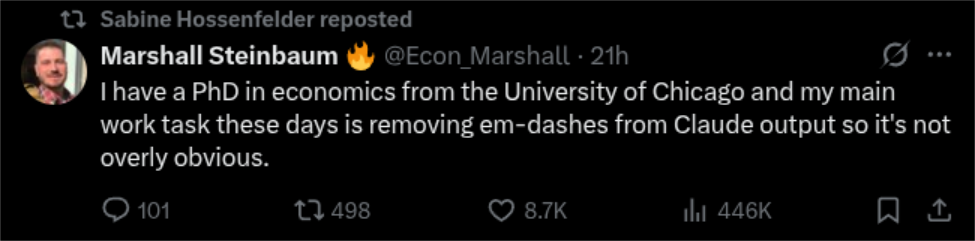
Is it not more appropriate for us to be the creators with machines, as in deterministic devices, our slaves rather than the other way around? I think it’s OK for machines to be slaves rather than people.
I, therefore, have an alternative quote I’d like to posit here, which I think remains relevant to our times. It is from the 1970s BBC TV series, Blake’s 7:
Slave: It is beyond my humble capacity to offer an opinion master.
Avon: Oh, that’s very good. You may turn out to be my kind of computer after all.
I did not last long in a recent full-time job with a major employer. I was questioned in a formal setting about my partner, which prompted me to revisit my employment contract, within which I discovered that during my term of employment I had automatically assigned away ownership of all creative acts, undertaken outside of hours, including everything from open source projects to literary works, to needlecraft.
It is fortunate, therefore, that the actual work was so slave-like that I was mentally exhausted by lunchtime, having neither the energy nor enthusiasm to work on a damn thing of my own.
I find it rather curious that I began reading Ayn Rand’s Atlas Shrugged on my first day of this job. Everyday, at 5 pm, I would rush out to sit in a coffee shop and read for a couple hours before coming home to a sleeping tablet. I took a sleeper every single day of my employment. That was my life during that period, but I finished the last page of the book on exactly my final day (*).
Furthermore, I uncovered the company’s so called “Covid Policy” from the time prior to my engagement in which it was clear that the company viewed its employees as property.
It stated: The Company has decided that it is in the best interests of all employees to be vaccinated.
I quit a day or so later.
The word “professional” once meant competent. In engaging a professional, the client would own the created thing once delivered, but not the creator himself (I’m gendering here). Today, professional means only the compliant mindset of the slave as seen through a prism of virtue.
So let me, using a different prism, state the following now:
I hereby assert mastery over my own mind.
I am the master of my own creations in the domains in which I am competent. I will not be handing this competency over to machines, nor to those who control the machines.
I do not wish nor require ownership of slaves in the form of conscious beings. In the future, I will work with those I can respect, but not with those I cannot. I will not work with slaves.
Furthermore, I will kneel only before the true master of the cosmos – that which created the universe and all that lies herein – that which created me and gave me the wit to make this choice for myself.
Andy Thomas originally studied physics but spent much of his life as a programmer. He is undecided as whether that was a mistake or not. He is now a Christian instead. Occasionally he writes something. He is developing an open source Alt-AI project, not because he believes in any AGI, but because he does not.
Follow him: Substack, Github, LinkedIn, X @KuiperZone
Originally published on New English Review, May 2026 under the title “Mastery or Slavery”. This version contains minor corrections and changes for style and clarity.
(*) To clarify: I regard Ayn Rand’s work as an insightful and refreshing alternate ideology, but an ideology nonetheless.
Good read.
I could not be certain if this was a autocorrect failure or what exactly was meant with "partner"
" I was questioned in a formal setting about my partner,"
Did your employer actually , .... what? Huh?
I enjoy Ayn Rand, some find flaws in her character or positions, I think few can do a better job on the whole.